Updated for 2026 to reflect current legal standards and best practice in England & Wales
By Eve, Founder of LexDex Solutions, LLM, GDPR Practitioner
20+ years’ experience in privacy compliance, data protection, and corporate legal frameworks.
£29.99
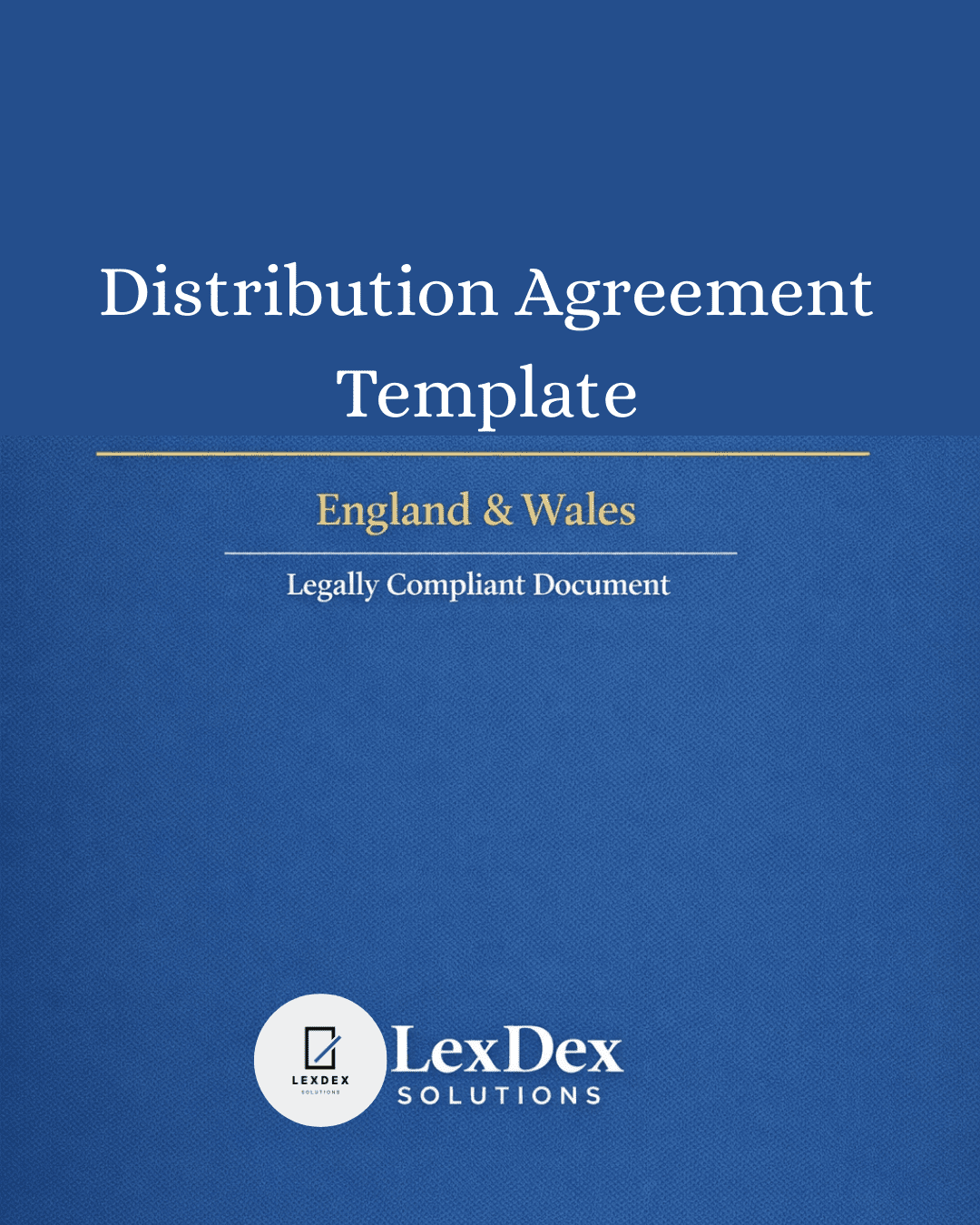
A Distribution Agreement is a legally binding commercial contract that sets out the framework for the supply and distribution of products or services from a supplier to a distributor. Rather than negotiating separate agreements for each transaction, a Distribution Agreement defines the key commercial and legal terms – such as product supply, pricing, delivery obligations, intellectual property rights, marketing responsibilities, confidentiality, and dispute resolution – providing a clear and enforceable relationship between the parties.
Under UK commercial law, distribution agreements operate primarily under general contract law principles while also engaging statutory obligations relating to consumer protection, data protection, competition law, and intellectual property rights. In particular, agreements governing the supply of goods to consumers must comply with the Consumer Rights Act 2015 and Sale of Goods Act 1979, while arrangements granting exclusive or preferential distribution rights may be subject to competition law scrutiny under the Enterprise Act 2002 and the Competition Act 1998.
Judicial authorities have also clarified the interpretation of commercial supply contracts in the UK. In cases such as Rainy Sky SA v Kookmin Bank (2011), the courts emphasised that contracts should be interpreted according to their natural and ordinary meaning, with commercial common sense applied in ambiguous circumstances. Earlier authorities, including Photo Production Ltd v Securicor Transport Ltd (1980), confirmed that limitation of liability clauses in commercial arrangements can be enforceable if clearly drafted and reasonable. These decisions highlight the importance of precise drafting in distribution agreements to avoid disputes and ensure enforceability.
This Distribution Agreement template establishes a comprehensive legal framework governing supply obligations, pricing, marketing responsibilities, intellectual property use, confidentiality protections, and liability allocation. By documenting these terms in a single agreement, organisations can reduce transactional complexity, streamline supplier relationships, and ensure consistent legal compliance across all distribution activities.
The Distribution Agreement template is suitable for businesses operating in sectors such as manufacturing, wholesale, technology products, consumer goods, retail, pharmaceuticals, food and beverage, and any commercial context where goods or services are supplied through distributors over time.
Distribution agreements in the United Kingdom are governed by general contract law principles alongside statutory frameworks regulating consumer protection, competition, and intellectual property rights.
Key legislation and regulatory frameworks affecting distribution agreements include:
Sale of Goods Act 1979
Suppliers must ensure that goods meet statutory standards, including satisfactory quality, fitness for purpose, and accurate descriptions. Distribution agreements must clearly define the supplier’s obligations to comply with these requirements when supplying products to consumers or retailers.
Consumer Rights Act 2015
Where products are sold to end consumers, statutory protections apply requiring goods to be of satisfactory quality and services to be performed with reasonable care and skill. Agreements must ensure that distributors comply with these statutory duties.
Competition Act 1998 and Enterprise Act 2002
Exclusive or preferential distribution arrangements must comply with UK competition law to avoid anti-competitive practices such as price-fixing, territorial restrictions, or market distortion. Well-drafted agreements include provisions ensuring compliance with competition regulations.
Intellectual Property Act 2014 and Copyright, Designs and Patents Act 1988
Distribution arrangements often involve the use of trademarks, copyrighted materials, or patented designs. Agreements must regulate ownership, licensing, and permitted use of intellectual property to protect the supplier’s brand and prevent unauthorised exploitation.
Data Protection Act 2018 and UK GDPR
Where personal data is collected or processed as part of distribution activities, responsibilities for lawful processing, security, and regulatory compliance must be clearly allocated between suppliers and distributors.
By structuring commercial supply relationships within a well-drafted Distribution Agreement, businesses can demonstrate compliance with these frameworks while establishing stable legal and operational foundations.
Manufacturers and suppliers
Companies producing goods or services can use a Distribution Agreement to regulate the terms under which distributors sell their products, ensuring control over pricing, territory, quality standards, and intellectual property use.
Distributors and resellers
Distributors who purchase goods from suppliers benefit from clearly defined rights and obligations regarding territorial exclusivity, product supply, marketing responsibilities, and payment terms.
Retailers and wholesale businesses
Retailers or wholesale businesses that rely on third-party suppliers can use distribution agreements to ensure consistent supply, quality standards, and legal protections throughout the commercial chain.
Legal advisers, contract managers, and procurement teams
Professionals responsible for drafting or negotiating supply agreements rely on Distribution Agreements to mitigate risk, reduce legal ambiguity, and ensure compliance with UK commercial law and statutory obligations.
Supply obligations and product delivery
The agreement specifies how products or services will be supplied, delivery schedules, minimum order quantities, quality standards, and inventory responsibilities. Clear supply obligations reduce disputes and ensure operational consistency.
Pricing and payment terms
Pricing, invoicing, payment schedules, and penalties for late payment are documented, providing transparency and reducing financial risk for both parties.
Intellectual property ownership and licensing
The agreement defines whether trademarks, patents, or copyrighted materials remain with the supplier or are licensed to the distributor, including conditions for use, branding, and marketing.
Marketing and sales responsibilities
Distribution Agreements often include provisions regarding promotional activities, advertising obligations, sales targets, and reporting, ensuring that products are marketed in line with supplier expectations.
Confidentiality and data protection
The agreement establishes binding obligations to protect sensitive business information, trade secrets, and any personal data processed as part of distribution activities.
Territorial and exclusivity rights
Where applicable, the agreement defines the geographic or market territory of the distributor, including exclusivity or non-compete obligations, to prevent conflicts with other distributors or suppliers.
Liability allocation and risk management
Liability, indemnity, and insurance requirements are clearly documented, mitigating operational, financial, and legal risks associated with the distribution arrangement.
A properly structured Distribution Agreement allows organisations to:
establish consistent contractual standards across supply and distribution relationships
allocate legal, financial, and operational risk clearly between parties
protect intellectual property and confidential information
streamline procurement, onboarding, and supplier management
demonstrate responsible governance and compliance to regulators, partners, and investors
For organisations managing multiple distributors or extensive supply chains, this governance framework is critical for maintaining operational stability and commercial credibility.
Contractual inconsistency across distributors
Without a formal agreement, each distributor relationship may be governed by informal arrangements, leading to confusion over pricing, supply obligations, and intellectual property.
Increased negotiation costs and delays
Negotiating separate contracts for each distributor can significantly slow down commercial operations and increase legal costs.
Intellectual property disputes
Without clear IP clauses, disputes may arise over trademarks, copyrighted materials, or proprietary designs.
Liability uncertainty and financial exposure
Undefined liability and indemnity terms can leave both suppliers and distributors exposed to financial and legal risks.
Regulatory non-compliance
Failure to document responsibilities for consumer protection, competition, and data protection obligations may result in regulatory penalties and reputational harm.
Consumer goods supply chains
Retailers, wholesalers, and manufacturers frequently use Distribution Agreements to manage the supply of consumer products, ensure compliance with quality standards, and protect trademarks and branding.
Technology and electronics distribution
Suppliers of electronic devices, software, or components rely on Distribution Agreements to manage licensing, product support, and marketing responsibilities across multiple territories.
Pharmaceuticals and healthcare products
Manufacturers use Distribution Agreements to regulate the safe and lawful distribution of medical products, ensuring compliance with regulatory standards, IP protection, and quality assurance.
Food and beverage supply
Distribution Agreements protect supply chains for perishable or branded goods, defining delivery obligations, sales targets, and marketing requirements.
International and multi-territory distribution
Companies operating across multiple regions use Distribution Agreements to define territorial rights, exclusivity obligations, and regulatory compliance for cross-border supply chains.
Investors, procurement teams, and business partners review supply contracts to ensure that distribution relationships are legally sound, commercially viable, and compliant with statutory obligations.
A well-drafted Distribution Agreement demonstrates:
consistent supply chain governance
clear territorial and exclusivity rights
protection of intellectual property and branding
compliance with UK consumer and competition law
preparedness for commercial growth, acquisition, or investment
For businesses operating in multiple markets or with complex distribution networks, this agreement plays a key role in operational stability and long-term commercial strategy.
Q1: What is a Distribution Agreement under UK law?
A Distribution Agreement is a commercial contract that sets out the terms under which a supplier provides products or services to a distributor. It establishes the overarching legal framework governing supply obligations, pricing, marketing responsibilities, intellectual property rights, confidentiality, territorial rights, and dispute resolution. The agreement ensures that both the supplier and distributor understand their contractual obligations while maintaining compliance with competition law, consumer protection regulations, and UK commercial law principles.
Q2: Why do businesses use distribution agreements instead of multiple individual supply contracts?
Using a distribution agreement allows businesses to formalise supply relationships with distributors, providing commercial certainty, operational efficiency, and legal protection. It reduces administrative complexity by setting out consistent terms for product supply, pricing, marketing, intellectual property, and delivery obligations, avoiding the need to negotiate separate contracts for each transaction. It also ensures that both parties’ rights and obligations are clearly defined and enforceable under UK law.
Q3: Are territorial or exclusivity clauses enforceable in the UK?
Yes. Territorial or exclusivity clauses can be enforceable when clearly defined in scope, duration, territory, and the parties’ obligations. UK courts will scrutinise these clauses under general contract law and competition law principles, ensuring they do not constitute anti-competitive conduct under the Enterprise Act 2002 or distort the market. Well-drafted agreements often include performance obligations, sales targets, and termination provisions to maintain enforceability.
Q4: How does a distribution agreement handle intellectual property rights?
Distribution agreements typically specify whether trademarks, copyrights, patents, or product designs remain owned by the supplier, whether the distributor is granted a licence to use them, and the conditions for such use. Clear IP clauses protect brand integrity, prevent unauthorised reproduction or resale, and ensure compliance with the Trade Marks Act 1994 and Copyright, Designs and Patents Act 1988. They may also define quality control standards and branding obligations for the distributor.
Q5: What are the supplier’s and distributor’s obligations under a distribution agreement?
The supplier is usually obliged to provide goods of satisfactory quality, ensure timely delivery, and offer marketing, technical, or operational support. The distributor is required to actively promote and sell products, comply with territorial restrictions, meet minimum purchase or sales targets, and protect confidential or proprietary information. Clearly defined obligations prevent disputes and provide contractual remedies for breach.
Q6: Can a distribution agreement be terminated?
Yes. Most distribution agreements include termination clauses that allow either party to end the contract under defined circumstances, such as persistent breach of obligations, failure to meet minimum purchase requirements, insolvency, or termination for convenience with appropriate notice. Clear termination provisions help mitigate business risk, protect commercial interests, and ensure compliance with UK contract law.
Q7: Does a distribution agreement cover regulatory and consumer protection requirements?
Yes. Distribution agreements allocate responsibilities to ensure compliance with the Consumer Rights Act 2015 and Sale of Goods Act 1979, including statutory implied terms regarding quality, fitness for purpose, and accurate descriptions. They may also cover industry-specific obligations, such as health, safety, and regulatory compliance in sectors like pharmaceuticals, food and beverage, or technology products.
Q8: Why is a professionally drafted distribution agreement important?
Distribution relationships often involve complex legal issues relating to supply obligations, intellectual property, competition law, consumer protection, marketing responsibilities, and financial terms. A comprehensive distribution agreement ensures both parties understand their rights and obligations, reduces the risk of disputes, protects brand and commercial interests, and provides a legally enforceable framework for long-term collaboration.
For a bespoke version of this document ask for a free quote

Updated for 2026 to reflect current legal standards and best practice in England & Wales
By Eve, Founder of LexDex Solutions, LLM, GDPR Practitioner
20+ years’ experience in privacy compliance, data protection, and corporate legal frameworks.
Only logged in customers who have purchased this product may leave a review.





Reviews
There are no reviews yet.