Updated for 2026 to reflect current legal standards and best practice in England & Wales
By Eve, Founder of LexDex Solutions, LLM, GDPR Practitioner
20+ years’ experience in privacy compliance, data protection, and corporate legal frameworks.
£29.99
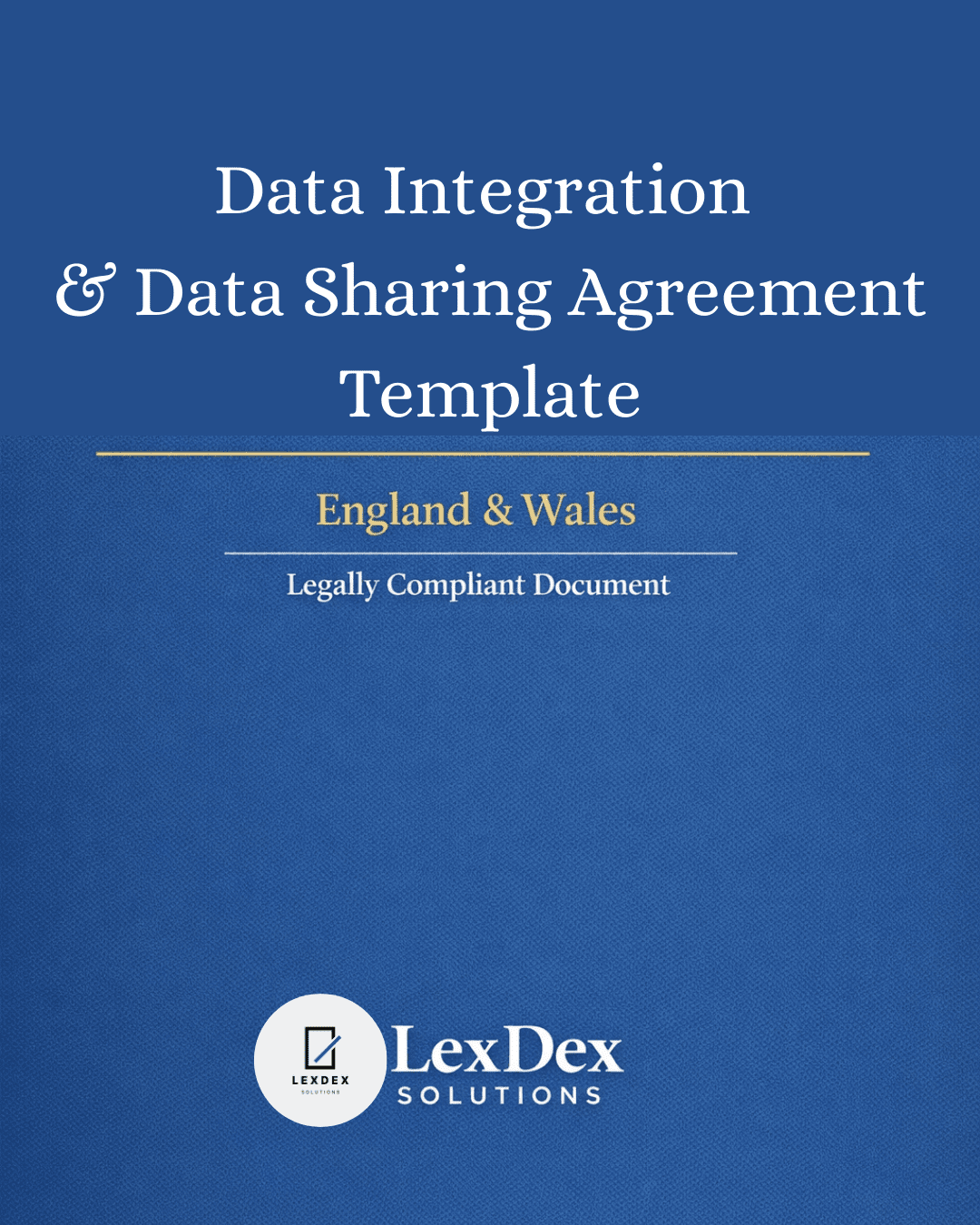
A Data Integration Agreement provides a legally robust framework governing how data is accessed, transferred, integrated, processed, and maintained between organisations or technical systems. It establishes clear legal, technical, and compliance boundaries where data flows between parties, platforms, APIs, or databases.
This Data Integration Agreement is designed to reduce legal, regulatory, and operational risk by clearly defining responsibilities for data protection, security, accuracy, system compatibility, and ongoing maintenance. By documenting the integration arrangements in a single binding contract, organisations can demonstrate accountability, compliance, and control over shared data environments.
This template is suitable for commercial integrations involving software providers, platform operators, data controllers, data processors, service providers, and enterprise partners across regulated and non-regulated sectors.
Technology companies and software providers
To formalise the legal terms governing how their systems integrate with third-party platforms, APIs, or client environments, while protecting intellectual property, limiting liability, and controlling permitted data use.
Businesses integrating external data sources
To ensure that inbound and outbound data integrations are lawful, secure, and clearly scoped, with enforceable obligations on data quality, accuracy, availability, and permitted processing.
Data protection officers and compliance teams
To evidence governance over data flows, demonstrate compliance with data protection principles, and allocate responsibility for security measures, breach handling, and regulatory cooperation.
Commercial solicitors and legal advisers
To draft, review, and rely upon a Data Integration Agreement that can withstand regulatory scrutiny, contractual disputes, and technical failures.
Scope of data integration
Defines precisely what data sets are shared, how data is accessed, the integration methods used, and the permitted purposes for processing, preventing scope creep or unauthorised use.
Roles and responsibilities of the parties
Allocates responsibility for data provision, transformation, validation, storage, maintenance, and error correction throughout the integration lifecycle.
Data protection and compliance obligations
Sets out legally binding obligations relating to lawful processing, confidentiality, security measures, data minimisation, retention, and cooperation with regulatory authorities.
Technical and operational standards
Specifies integration protocols, service levels, uptime requirements, testing obligations, change management procedures, and compatibility standards.
Security and incident management
Establishes security controls, access restrictions, breach notification timelines, remediation duties, and audit rights in the event of data incidents.
Intellectual property and ownership
Clarifies ownership of source data, derived data, integration tools, and documentation, reducing disputes over reuse or commercial exploitation.
Liability, indemnities, and risk allocation
Allocates financial and legal risk arising from data inaccuracies, system failures, security incidents, or regulatory breaches.
Termination and data exit obligations
Controls how integrations are unwound, including data return, deletion, continued access restrictions, and transition support.
Unlawful data processing
Without clear contractual controls, data integration may occur without a lawful basis, exposing parties to regulatory enforcement and penalties.
Unclear liability for data breaches
In the absence of a Data Integration Agreement, responsibility for security failures or breaches may be disputed, increasing litigation risk.
Operational and commercial disruption
System outages, data corruption, or incompatible changes can lead to service failures without clear remedies or accountability.
Intellectual property disputes
Unclear ownership of integrated or derived data can result in costly disputes and loss of commercial value.
Failed audits and due diligence
Investors, customers, and regulators increasingly require documented governance over data integrations. Missing agreements can derail transactions.
API integrations between SaaS platforms
Enterprise system-to-system integrations
Data feeds between commercial partners
Platform onboarding of third-party service providers
Migration or synchronisation of customer or operational data
Q1: What is a Data Integration Agreement?
It is a legally binding contract that governs how data is shared and integrated between systems or organisations, defining technical, legal, and compliance responsibilities.
Q2: Is this different from a data processing agreement?
Yes. While there may be overlap, a Data Integration Agreement is broader, covering technical integration, system responsibilities, service levels, and commercial risk allocation alongside data protection.
Q3: Who should enter into a Data Integration Agreement?
Any organisation that shares or integrates data with another party’s systems, platforms, or software should use a Data Integration Agreement.
Q4: Does this agreement cover API integrations?
Yes. The template is suitable for API-based integrations, platform-to-platform connections, and other automated data exchange mechanisms.
Q5: How does this agreement support regulatory compliance?
It documents governance, accountability, and security controls, providing evidence of compliance during audits or regulatory investigations.
Q6: What happens if the integration fails or data is corrupted?
The agreement allocates responsibility, sets remediation obligations, and defines liability and remedies for integration failures.
Q7: Can this agreement be used internationally?
Yes, but it should be reviewed and adapted where cross-border data transfers or local regulatory requirements apply.
Q8: Should the agreement be reviewed over time?
Yes. Data integrations evolve, and the agreement should be reviewed periodically to reflect system changes, regulatory updates, and commercial developments.
For a bespoke version of this document ask for a free quote

Updated for 2026 to reflect current legal standards and best practice in England & Wales
By Eve, Founder of LexDex Solutions, LLM, GDPR Practitioner
20+ years’ experience in privacy compliance, data protection, and corporate legal frameworks.
Only logged in customers who have purchased this product may leave a review.


Reviews
There are no reviews yet.